
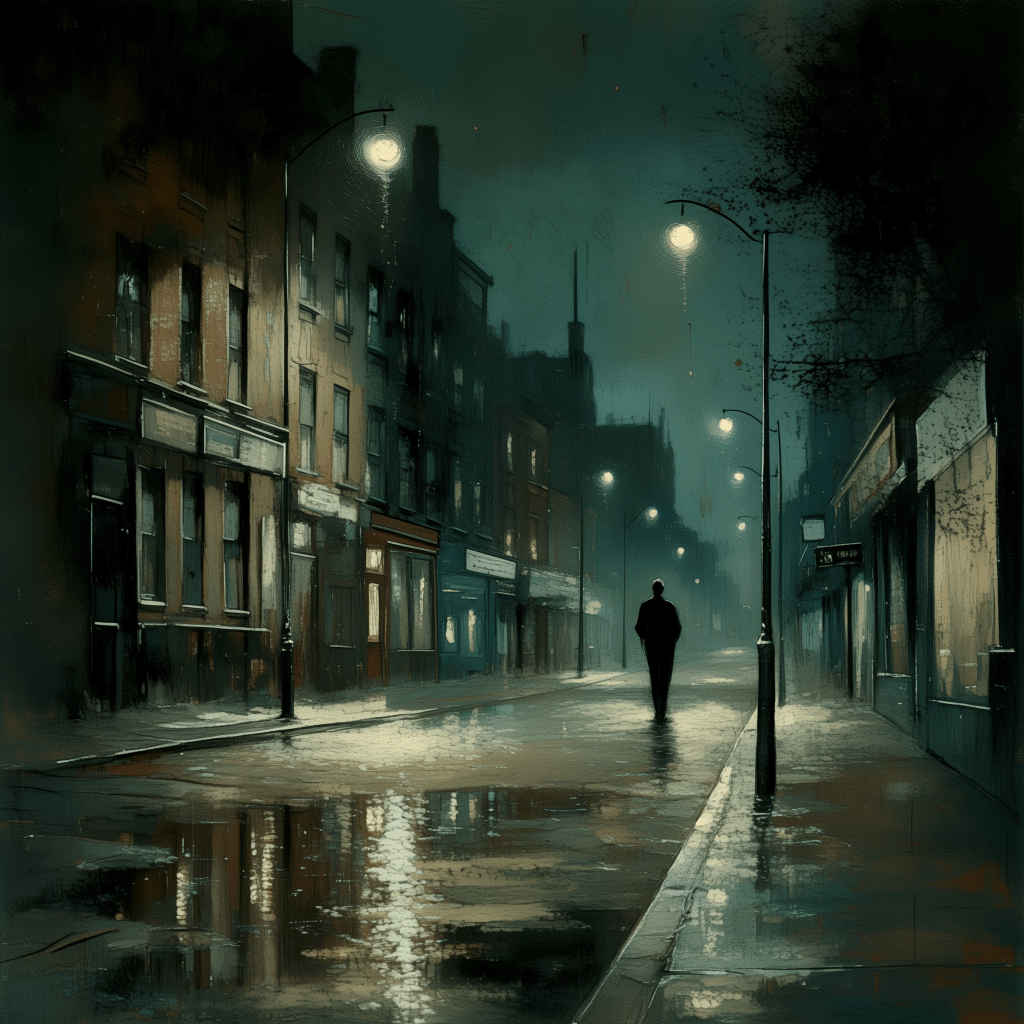
West Parting Bridge
A man follows his shadow through familiar streets toward a new life across the river. But not everything can cross West Parting Bridge.
This piece was my submission to the Verdant Owl Writing Battle competition. You can also find the story on the Writing Battle website.
In my hands was all I’d deemed worthy to keep from my flat: my entire life in a box between two hands.
Southside was quiet at that hour. Everywhere I passed was closed or boarded up, all dark except the late-night chicken shops and bars that spilled white light on wet pavement. Their interiors were clinically bright and utterly empty.
My shadow walked ahead. He knew the routes better than me. He remembered the cut-throughs that were well lit, the corners where men and their shadows gathered. There was no need for me to remember, when I could simply follow his footsteps.
He was my silhouette, formed of black smoke, soft and impermanent, head down as he moved through the white streetlights. The faded edges of his feet passed through puddles and pavement without a sound.
I’d turned down Dot’s offer the first time without much thought. A spare room in North Cabacan had felt like too much of a change. I already knew Southside, the nearest grocery store, the nearest laundromat. It was easier to stay where I was.
I stepped off the curb without looking.
A bus horn blared. Two tiers of steel lurched past, squealing on wet tires, close enough that I saw my own face wide-eyed in its mirror-glass. The rush of it knocked me back to the pavement. I stood there a moment collecting myself, dazed but unhurt.
My shadow had scattered with the rush of wind. He reformed slowly where he had stood, drawing himself back together from the slivers of dark between passing brake-lights.
“Pay attention,” I muttered.
He did not react. He simply began walking again, straight through me and across the road. I checked both ways, then followed him.
The second time Dot had offered, I thought about it a little while longer. The room was reasonable. It was smaller than my flat in Southside. It was on a louder road. But it had access to the Archives.
I had refused her offer again. Southside was familiar. Familiar was manageable. My shadow had agreed, or I’d assumed he had, since he had waited in the dark of my flat, sat back at the desk, and continued to work as we always had before. I thought he was showing me what I wanted, but in truth he only ever revealed what I was.
He turned down a narrow road toward West Parting Bridge. Brick walls surrounded both sides, covered in black murals of scattered poses.
A coffee van was parked at the end of the road, just before the bridge. Its hatch was open and it was warmly lit, even at such a late hour. I couldn’t see its owner, only their shadow sleeping on the counter, head down.
The bridge itself was old stone, yet wide enough for two lanes. Across the water, North Cabacan’s tower-flats were stacked tall and bright. The reflections of their orange windows were stretched across the water like strings pulled taut back to Southside.
Three years in Cabacan and I hadn’t crossed.
I had almost passed the van when my shadow stopped beside it. He looked up through its hatch, then turned to me and yawned. I caught the yawn without meaning to.
It was almost one in the morning. I hadn’t realised how tired I was until he showed me.
I went over and ordered a coffee.
The woman behind the counter worked without a hurry. Her shadow slept on, undisturbed.
“Moving north?” she said.
I shifted the box to my hip. “Moving in with a friend.”
She glanced at me and my shadow, back-and-forth, gave a knowing look, then returned to her work.
“Why are you open this late?” I asked.
“For people like yourself,” she said. “Some sit a while before they cross.”
There were plastic chairs on the pavement beside the van. My shadow had already slumped in one, head dropped into his hands.
I nodded, thinking I knew what she meant. I accepted the coffee and paid.
“Come on,” I said to my shadow.
I was tired too. But we had already delayed long enough, and Dot’s place was still several streets into North Cabacan.
The third time Dot had offered I’d said yes before I could talk myself out of it. She had visited me in my flat. It was only by seeing it through her eyes that I saw how claustrophobic it had become. What had seemed familiar was no longer manageable.
The coffee scalded the tip of my tongue as my shadow caught up, reforming beside me in the streetlight.
I stepped onto the bridge, my footsteps quiet on the pavement. A breeze rolled over the railings, fresh and cool as if it had been carried all the way from the sea into the city. I took a deep breath and felt lighter for it. I only ever noticed the weight of the city-air, the exhaust fumes, the smoke, once free from it.
I turned around. My shadow was still standing at the start of the bridge, right where it had reformed in the streetlight.
“Come on,” I said. “We’re nearly there.”
But there he stood, stark still.
I hurried back to him.
“He can’t cross,” the van owner called over. She was wiping down her counter. She nodded toward the murals on the brick walls. I had thought they were painted figures. But they were shadows, discarded on the riverbank, left to seep into brick and mortar.
“He won’t follow you,” she said.
I looked at him a long moment. It was impossible to know if he was looking back: there were no eyes in the smoke.
I couldn’t walk away from him. He knew the right paths. He knew them better than I did. I wouldn’t know what to do without him. I didn’t know the cut-throughs, the corners to avoid. I could take a wrong turn in the unfamiliar city, end up in a dead-end, get turned around, or lost. I could choose so wrong.
He had always been the one choosing. It was easy to let him. He remembered everywhere we’d been, everything we’d done. He knew what was safe, and quiet, and easy. And now the bridge was behind me, and it was the middle of the night, and I was expected to simply walk it alone.
The box was heavy. I set it down on the pavement and crouched over it, started shifting the contents within to give my mind something else, anything else, to think about. There was little at all in the box; a folded jumper, a phone charger coiled around itself, a chipped mug I’d had since I moved to Southside. At the bottom was a handheld archive reader.
It was a small thing, the kind they issued to researchers in the Archives before terminals became the standard. I had bought it second-hand, for cheap because of the crack through the middle of the screen. I’d got it when I was still a student, before Cabacan, when I had still believed I could be the type of person to spend long hours collecting sources in the Archives. I hadn’t used it in over a year. At some point it had slid to the bottom of a drawer and stayed there.
It still turned on. One half of the screen lit white, the other stayed dark. It pulled up a long list of essay drafts, all timestamped to the small hours of mornings over a year ago, when I couldn’t sleep and so found myself instead reading about the Cabacan Collection, about all the secrets of the Archives that were still untranslated. None of my essays were finished. By morning, they had all seemed so pointless.
I wanted to go back, retrace our steps, and find a way to make it work in Southside just a little longer. It’s easier to stick with what you know. But the flat was already cleared out, keys handed back. There was nothing left to return to.
I tucked the reader back into the box and stood.
“I’ll be alright,” I said. I’m not sure I believed it.
He didn’t move.
I turned back toward the bridge. My legs felt unused, like I was walking for the first time in a long time, so I focused only on my feet and counted the rhythm. I followed the line of the railing, since there was nothing else to guide me.
The breeze came off the water again and the air was cold in my lungs. I stopped and turned. I looked for him in the streetlight, but the road was empty, just black murals burned into brick walls.
The north side was unfamiliar. The pavements were wider, the streetlights were higher. The buildings were organised neatly into squares and yet the roads seemed more confusing than Southside ever had. But the Archives opened at eight, and the reader was tucked into my box, and somewhere further north Dot had left a spare key out and a light on.
 Mirrortide
Leave a comment