
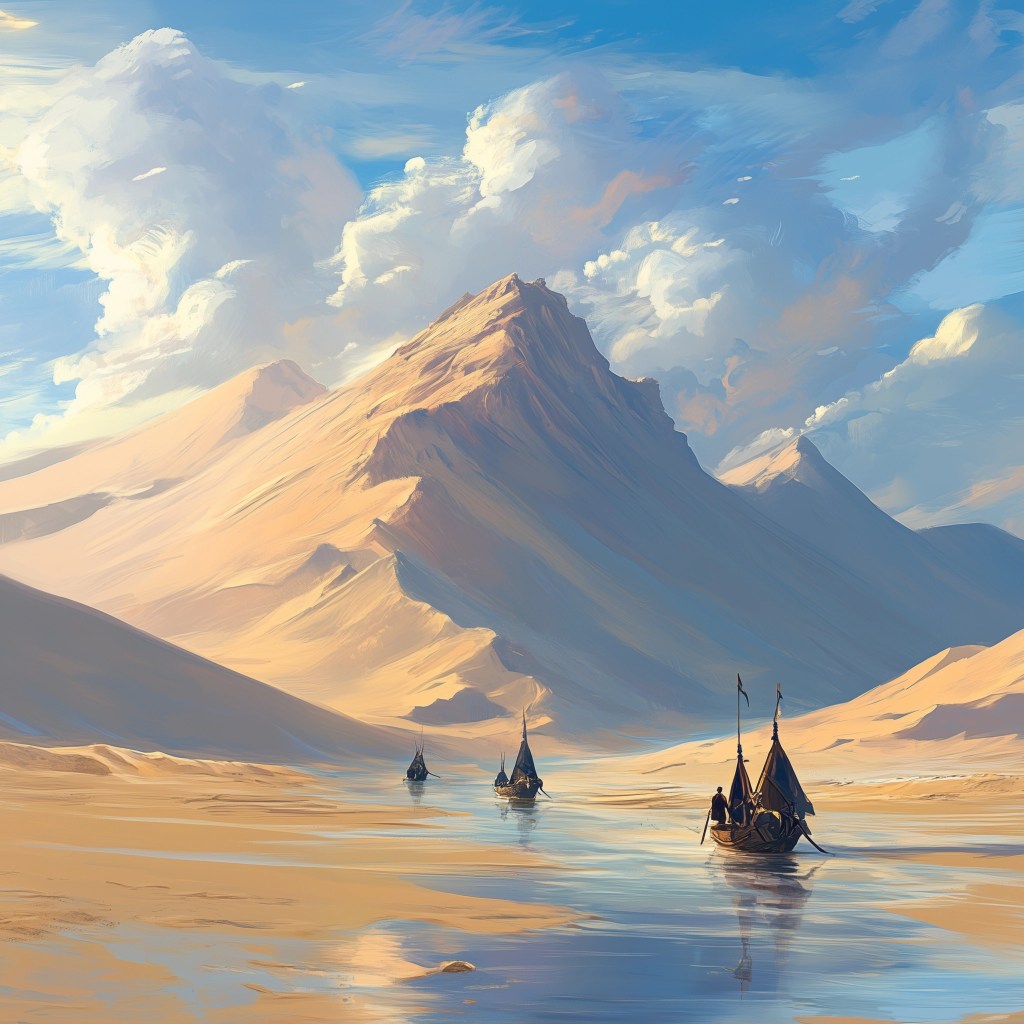
The View from the Glass Mountain
A captain of a sandship and his crew face imminent starvation and the countless dangers of a desolate desert world. But a girl is found in a wrecked ship, demands to be taken to the Glass Mountain, and claims to have had visions from the world-goddess.
I wrote this novelette at the start of this year (2025) and submitted it to a writing competition. Didn’t win anything though, so here it is now!
I.
“Brace!” a low voice called from high on the stern. But as swift as it appeared, the word was ripped away by strong gales – another grain of sand on the glassy winds. And as he called, the ship reared, the prow raising high into the air until all beyond was blue sky. For a moment it seemed to hang there motionless. But down it came with a resounding crack, the ship’s hull slamming into the desert, throwing waves of sand high over the front deck. The crew ducked away, holding their wrapped scarves firmly over their faces, as streams of sand bounced from wide goggles. The boat slid down the dune on its glass hull, its twin keels carving lines like skates through ice.
The ship lurched as its two great paddle wheels dug deep into the desert again. Their bronze shovels scooped at the sand and clawed the boat forward. A great propeller, its blades glinting in the cold sunlight, spun high above the deck on a tall mast. It caught the headwind, whirring with a loud hum, and shook the boat. And, as the turbine spun in the strong gales, sand streaming over long blades, it pulled at the great paddles below and drove them into the soft sands.
“Nicely done, crew,” the captain called, raising again to his feet. He ran a hand through his short hair, dark though greying at the sides, and brushed away the sand that was gathering in his cropped beard. He pressed a hand to his creased brow, shielding the morning light from his weathered eyes, and surveyed the horizons.
But there, from between the grains he spotted it. Something buried in the sand, a dune piled over it. A faint glimmer submerged in the sable sea – perhaps a mirage, or maybe their salvation.
“A wreckage, captain!” the spotter called from the prow, lying flat at its pointed tip, eye pressed to a long telescope.
“I see it,” he called back through the winds and pointed in its direction. “Bring us round, crew. Keep it going.”
And the crew began to move again. In lines they sat, two by two, in recesses along the deck, feet firmly planted on slanted deck-boards. In their gloved hands they held the metal crossbars of long chains and together they heaved in a simultaneous row. The chains’ ends fed below the deck boards with each stride but could be heard churning and clicking within the ship’s great gearbox. And after each heave, the crew would wait, resting between the dunes and recovering their strength. Then, at the next wave, they would pull again, digging the paddle wheels through the sand and thrusting the boat forward over steep crests.
Each member of the dozen or so crew was covered entirely in tightly-wrapped fabrics of white and beige. They wore bulbous blue goggles over their eyes and leather belts and bandoliers across their bodies. Some displayed flashes of colour in their choice of fabrics, adorning their shoulders or waists in blue or bronze, showing slight individuality within a uniformed crew.
With the crew maintaining the course, the captain crouched down and pulled up a hatch on the raised stern. He lowered himself into the dim cabin, cramped by shelves of hardwood bunks. A wide table jutted out from the end of the darkened hollow, cluttered with curling maps and open books. A young man with thin glasses, black hair scraggly over his boyish face, craned over it all. He drew lines along measuring sticks, picking up strange navigating tools and placing them down in various places, as he frowned at the mess.
“There’s a wrecked skiff,” the captain said.
“Thank the gods,” the boy said with a sigh. “I can’t think straight like this, captain. All I can think about is my gut and the growling and what, if anything, around here is edible. You know you can’t digest paper, captain?”
There were tear marks at the corner of the map.
“There’ll be supplies,” the captain said, hunched in the shallow cabin. “It’ll keep us going. How long to Kohzawin?”
“My best calculation, captain,” the boy said. “Five days. Minimum. But that’s with good gales and full effort. A couple days to the glass river then another three to Kohzawin. But if we hit any blocks or breakages or delays or…”
“Calm down, Taimé. We’ll make it.”
The boy was nervously tearing at another corner as he peered at the many lines he had pencilled across the map.
“You’re certain there’s nowhere nearer to restock?” the captain said. But he knew it was a foolish question. They were in the southern sea, far from the mountain ridges that crested above the sands. They were far from any of the rocky islands that sheltered lonely farm-towns.
“It’s only two days back to Chishomishé-”
“We’re not turning around.”
“If we’d had more time to restock-”
“Focus on what’s next, not the past,” the captain said. “Focus on the fastest route to Kohzawin.”
“It was just a farm-town, and the folk seemed nice enough, I don’t see why-”
“That’s an order.”
“Yes, captain. Sorry, captain,” the boy muttered.
The boy returned to his maps and instruments, but his movements had become sluggish. His morale had been sapped away. It was no way to run a good crew.
“Look, Taimé,” the captain began again with a softer tone. “You follow my orders because I’m your captain, we both know how this works. But as your captain, my job is to keep you safe. All of you. That’s part of the deal. The twelve of you are my family. I think of us as family, and I’ll keep you safe as family.”
The boy scoffed. “Okay, dad.”
“More like an older brother.”
“Don’t kid yourself captain, your beard’s greyer than gunpowder.”
He laughed. “Then consider yourself lucky I’m just your captain: I wouldn’t let a son of mine be such a smartass.”
*
Finally, they reached the sunken skiff. It was mostly submerged in sand, upturned beneath a dune. Its rear propeller was broken, the blades sundered and tossed aside. Its glass hull scattered light across a fractal of broken edges.
The crew slumped in their seats, exhausted, and a heavy anchor was thrown into the ship’s wake. Its wide claw raked through the sand, dragging the boat to a stop.
The captain was lowered onto the sands by a rope and two crew followed close behind. He gestured to the others to stay at a careful distance, drawing his pistol as he neared the wreckage. He snapped open the narrow barrel, checking the lonely bullet in its chamber, before returning it with a click.
He leaned beneath the upturned skiff – a thin sliver between the sand and its cracked glass hull. The hollow interior was dim but speckled by the fractured light that split through the hull’s cobwebbed cracks. Its sparse contents were beginning to cover by sand, blown in and burying. Nestled between crates was a bundle of fabrics – a bedroll strewn over the sand and sheltered from the tearing winds.
There was a click to his right. A familiar cocking of a pistol, just by his ear.
“Take me to Lazévon,” she said. A girl’s voice, stern and commanding but subtly trembling.
“And you’re going to hold that to my head the entire way?” He turned slowly under the deadly point of the pistol, his eye beneath its barrel.
Wrapped in many brown and beige fabrics, she was difficult to discern, hidden in a small, shaded corner of the skiff. But she was just a kid. Her mouth was covered in a thick scarf, muffling her voice. Her dark hair was long but messy, pinned away from pale eyes.
“If I have to,” she said, holding the pistol tight in both hands, shoulders tensed.
“And if I refuse?”
“Then I shoot you.”
“Ah. That’ll be difficult.”
“And why’s that?”
“It’s not loaded.”
She scrambled away, turning to flee deeper into the small skiff. But he was too fast. He grabbed her by the nape of her scarf, trapping her. She squirmed, but he held her still in his grip.
“We have no supplies for a stowaway,” he said. “So, give me one good reason why I shouldn’t leave you here to starve.”
She’s just a kid, he thought. Please come up with a good reason.
She stuttered as she pushed against his grip, “I’ve been chosen by the world-goddess!”
He sighed, dropping his head slightly.
“Bold. Really, I respect the choice. But I was expecting something real. A good deckhand, a shooter, a cook…”
“I’m not lying.”
He smiled.
“And I suppose I just have to believe you, huh? Really, I respect the hustle.”
“I remember the waking of the world,” she said. “I remember the rivers of glass when they came from the mountaintops. I remember the first cities, buried by falling sand. I remember the sandsharks when they first tunnelled through the dunes, tiny in a vast ocean.”
“Great acting. Shame we don’t need actors aboard.”
“Please. Every night, I see the Glass Mountain. It’s in my dreams. At the summit, there’s a shrine to the goddess. I have to get there. It must be important.”
“And that’s why you’re in a cracked skiff in the middle of the sea?” he scoffed.
“Yes,” she said, no hint of humour. “We were attacked by marauders. They killed them all.”
He scrutinized her as she spoke, her voice breaking with that final phrase. With only the upper half of her face visible, her eyes were the only tell of her honesty. She was yet to do anything deserving of his trust, but still he saw no dishonesty in her eyes.
“I can’t trust you just on your word. You either have some way to prove this… spark of divinity… or you’re left here. Simple as that.”
His words were stern and final, but he felt a solemn guilt as he weighed the options. He didn’t want to condemn this child to death, deceitful or not. But his crew would mutiny if he brought aboard another mouth to feed without good reason.
“I know the song of the world-goddess.”
“Ha – then sing it.”
She hesitated. But he tightened his grip. She closed her eyes, her brow creasing under intense focus.
She began to hum a melody, short but precise. The notes moved in strange orders, stumbling between discordant keys. But as she repeated the short tune to herself, wordlessly humming beneath her scarves, the air began to ripple. The still air beneath the skiff turned turbulent, strands dancing their own directions. Winds picked up, as if crawling through the cracks, flicking loose fabrics about her body, spiralling her dark hair. The gales began to howl within the hull as she continued, pummelling uncovered skin as it carried grains of sand, tearing as whistles past ears.
The captain watched in awe. He had heard of the magi, with their songs to twist the world to their whims, but never had he witnessed it. For their ancient songs to be learned and repeated by just a kid was miraculous. Even though her plea was clearly untrue, this was wondrous enough to prove her worth to the crew. They would find a use for her aboard the ship, or certainly a job when they reached Kohzawin.
“Stop,” he said, and her song ceased. The air settled again, dropping the grains from the swirling cloud.
“You can come with us.”
*
Lifted back aboard the ship, he firmly placed his hand on her low shoulder and held her forward amongst a gathering crowd of a dozen covered faces. From behind wide goggles they stared at her, arms crossed or hands on hips. Though concealed, their scowls were evident even behind many wrappings.
“Welcome, crew, to our new member,” the captain announced, patting her shoulder.
“Captain-” A tall figure stepped forward, his voice serious. His chest was covered by a dark breastplate, pocked with brown corrosion, strapped tightly across his torso.
“She may be a little small for rowing, but she’ll help on-deck.”
“Captain-” the man repeated, revealing his dark eyes as he removed his wide goggles.
“Shoja, she’ll report to you,” the captain continued. Another crew member rocked their head up to the sky with a groan. “Have her clean the decks, fix breakages. Keep her busy but treat her well.”
“Captain. We can’t take any more crew.” The man’s words pierced through the captain’s announcement. His eyes were deadly serious, veiled by wicks of dark hair. “We have no supplies. We’ll never reach Kohzawin.”
“She’s only small, Koga. She won’t need much.” He flashed a charming smile to the crew. “And her skiff has some supplies. It’ll keep us going.”
“It won’t be enough. I’m sorry, but we can’t.”
The captain’s smile dropped with a sigh. “She’s more than she seems. She knows ancient songs.”
“She’s not a magus, Captain, c’mon.” The tall man shook his head in disappointment.
“Show them.” He shook the young girl’s shoulder.
“I can’t,” she muttered.
The captain laughed shakingly, leaning close to her ear.
“Sing a song or they’ll leave you on the sands,” he whispered, teeth bared in a hollow smile.
“I’ll forget,” she said. But his fingers dug into her shoulder. Her breath shifted unsteadily. A dozen pairs of goggles were glaring, each a head and shoulders above her. She took a deep breath, closing her pale eyes, and buried her face further into her scarf.
She began to hum as she had before, a short, strange melody moving in waves like rolling dunes. And, as her tune wove together disparate keys, muffled beneath thick fabrics, the winds picked up once more. Sandy gales swirled around her, a cyclone with her in its eye, twisting and twirling. The captain shielded his face from the ripping sands as the gales built and roared.
“That’s enough.” He shook her shoulder. And as the melody ceased, so too did the winds, carpeting the deck with a sudden layer of sediment.
The crew stood frozen. The tall man was wide eyed and mesmerized, gripped by a strange blend of awe and fear. The girl’s eyes opened again as she spluttered a dry cough into her scarf. But, as her gaze raised to the surrounding crew, her face scrunched in confusion. When she noticed the hand on her shoulder, following it to the face of a bearded man, she flinched in its grasp.
The captain addressed his crew with a smile, patting her shoulder again.
“We continue to Kohzawin. Keep her safe.”
But she twisted in his grasp, swatting his hand away. He spun around with his other, grabbing her by the arm before she could flee.
“What the gods are you doing?” he said.
“I need to reach Lazévon,” she hissed.
“Yes, you’ve said that already. You can go after Kohzawin.”
But she squirmed in his grip.
“Get off me. Put me back on my ship.”
“The one shattered in the sands?” He glanced off the prow to the sunken skiff, its hull broken and buried.
“What, no, we were…” but her words trailed off as she followed his gaze to the sunken vessel. The tension across her body fell away.
“What’s going on?” the captain asked, releasing his grip.
“Did I sing?”
“Twice.”
A heavy sigh escaped her lungs, and her limbs collapsed along with it. She fell to her knees on the sand-filmed deck.
He felt a series of questions rising through his throat, but he stoppered them. He turned to the dozen figures, watching intently, all leaning curiously toward the strange display. He swatted them away with a wave of a hand and they quickly disbanded, hurrying in random directions across the deck, heads down pretending not to have noticed the odd outburst.
The captain kneeled beside the girl and spoke quietly.
“You’re safe with us. We’ll get you to port and work it out from there, okay?”
She hardly reacted; eyes fixed on the upturned skiff.
“I’m Otto,” and he squeezed her shoulder with a warm smile. She did not turn, but mumbled in reply,
“Zefira.”
II.
“Gather round,” shouted the captain, shrouded by an indigo sky, his edges lit faintly by the great blue moon. He leapt down from the raised stern, lumbering a wide crate in his arms.
“Feast’s ready,” he scoffed as he placed the crate down on the dim deck-boards.
The crew, lazily strewn across their seated chain-rowers, exhausted from a day’s toil, sprang to life. They swarmed around the captain, buzzing in a tight circle, clambering to be first. They removed their wide goggles and face-scarves as they drooled for a long-awaited meal.
The captain lifted the lid, revealing the shadowy contents with a slight crack. But as soon as the seal was broken a dozen hands shot forward, each vying for first pick. A long-armed man managed to slip through first, but quickly recoiled, shaking his hand as he spat a string of curses. He narrowly dodged the lid as the captain slammed it back down, hard on slower knuckles.
“Have some patience, you dogs.” The captain scowled at them. He held down the lid on their wriggling hands. “Wait ‘til you’re given your share.”
Each figure sheepishly retracted their hand, rubbing their bruised knuckles or averting their eyes. The long-armed man plucked at the thin needles now embedded in his bony fingers, muttering under his breath. A short man with square shoulders, who was too slow to react so avoided the snare, nudged his neighbours with a sly smile,
“Wait your turn, dogs.”
But another pushed him back harder and sent him stumbling across the deck. And, if it weren’t for a third stepping between them, he would’ve retaliated further, ready to throw the ship into a brawl.
“It’s half each. That’s all we have,” the captain continued. He lifted the crate lid again and sternly eyed each figure.
Within the crate, there was a pile of just six cactus bulbs. Each about the size of a fist, round and plump, though pricked with many sharp needles. The crew warily watched, fidgeting on their feet as they leaned over expectantly. The captain plucked a bulb from the box, holding it in rough hands, fingers placed delicately between the sharp spines. And with two thumbs he pressed into its crown. Its taut skin ruptured, tearing in two, and revealed its translucent flesh. The crew twitched at the sight of it.
“Eat it all but the spines. It’s no time to be picky,” he spoke as he handed out the halves, one by one.
The figures snatched them when offered, fled to distant corners of the deck, devoured and slurped, hunched over their small pieces to shield from jealous eyes. They pricked their fingers as they ate, carelessly handling the bulbs, pocking their skin with broken needles. But though they cursed under their breath, they were not slowed by the pain.
“Slow down,” the captain called across the deck as he split the final bulb. “Pull out the spines first or you’ll hurt yourselves.”
But they ignored him, yelping occasionally in their lonely corners of the deck.
“Let them make their mistakes, Captain,” Koga said, the last in line. He held one hand out expectantly, the other tucked into his rusted breastplate. “Otherwise, they’ll never learn.”
“Or they could just do what I tell them.” The captain handed over one half of the final bulb. But when Koga retreated to his own corner of the deck, he revealed a small girl, hidden behind his tall silhouette.
The captain pressed a hand against his brow, muttering a curse against himself. Thirteen now. Not twelve. He sighed but held the final half out to her. She reached out toward it but hesitated.
“What about you?” she said.
The captain smiled, brandishing a charming smile of certain confidence.
“A captain never eats before his crew.”
“That’s stupid,” she said, and the captain broke with a laugh.
“I’ve survived much worse,” he said, gesturing the piece toward her. She took it, carefully avoiding the painful spines, and ate slowly. Its gelatinous core was smooth and sweet; and though its thick rind was tough and bitter, it was nourishing all the same.
III.
“We should begin turning north, captain,” the scraggly-haired boy said. He lurched with the ship as it crested dunes, holding himself precariously within the stern’s open hatch.
“Then how long until the glass river?” The captain was crouched beside him, pressing fingers over his weary eyes.
“At best… another day?”
The captain sighed, plucking at the greying hairs of his short beard. He lifted himself to his feet, loudly addressing the crew from the raised stern.
“Begin to turn,” he called across the deck. “Port side, due north.”
“No!” All eyes turned suddenly to the young girl, who had been set to sweeping the incessant sands from the wide decks. “We can’t go north here,” she shouted.
“We have a navigator for a reason.” The captain smiled at her in disbelief.
“There are sandsharks.”
The captain laughed, turning to the boy beside him, half sunken into the stern. “Any history of sandsharks here?”
The boy rubbed his head with a puzzled look. “Never heard of them down here. Further north, sure. But much further north-”
“They’re migrating,” she shouted.
“Migrating? They don’t migrate?”
“They move with the shifting surface beneath the sands.”
“That’s… that’s not a thing.” The boy shook his head bewildered.
“If we continue east-”
“Zefira,” the captain interrupted her. He spoke sternly, enunciating each word in turn. “We’re heading north. We have no time for detours. Am I clear?”
He could see her objections bubbling up, but she silenced herself uncomfortably. She tore her gaze from the captain, passing over the dozen figures all watching intently. She fidgeted and began sweeping again in a huff. And with that, the crew returned to their tasks with murmurs and laughs.
“Captain,” the young navigator whispered, beneath the rumbling of the ship and its crew. “She wanted to reach Lazévon, right? The Glass Mountain?”
“What’s wrong?”
“It’s due east from here. I think she’s trying to divert us there. Everything she said was absolute nonsense.”
The determination of that girl was admirable, even if foolishly stubborn. Though her lies could certainly use some work. Marauders he might’ve believed. Sandsharks were a little too far-fetched.
“What about the Glass Mountain?” he said. “Should we be concerned?”
“I don’t think there’s much there at all, captain,” the boy said. “It’s a place of pilgrimage. There’s supposed to be a shrine up there, but that’s about it. Doesn’t seem worth the climb.”
“I’ll keep an eye on her.”
The ship began to shift in a wide arc. One half of the crew rested as the others heaved at the rowing chains on just one side. The great paddle wheel dug deep into the sand and drove faster through it, twisting the ship in a slow angle northward.
Once the ship had twisted to follow the northerly winds, the captain descended to the lower deck and approached the young girl. There, she swept at the floorboards with a ratty broom. With every sweep a gust of wind would release its grains onto the ship, undoing her work.
“Zefira,” the captain said gently.
“I wasn’t lying,” she quietly snapped, her eyes still low on the crooked deck-boards.
“I’m taking a huge risk keeping you here. The more attention you bring to yourself, the more everyone here will want you off this ship. Soon they’ll be a pack of dogs, ravenous and exhausted. They’ll throw you over first when the fighting starts. So lay low, for gods’ sakes. Understand?”
She did not reply. She continued to sweep the deck in a sulk.
“I said, do you understand me.”
“I wasn’t lying!” she repeated, eyes darting up to his. There was that same exasperated honesty. “I’ve seen it. I’ve seen how the continents shift. Why won’t you believe me?”
“You can’t let dreams deceive you.”
“They’re not just dreams,” she snapped. “The goddess gave them to me. They’re important. I’m important.”
“You are important, Zefira. Everyone’s important. Don’t throw that away for some absent goddess.”
“Do you have visions from the goddess? Didn’t think so.”
He sighed, delaying his response to let the tension settle.
“I know what you’re going through, okay? When I was a little older than you, I ran away from home too. My father tried to talk me out of it. He told me to stay in Chishomishé, where I’d be healthy and happy. But I left anyway. I stowed away on a shipping freighter from the south. And do you know what happened when the freight-captain found me?”
She did not reply.
“He lashed me, punished me for taking the place of a barrel in his shipment. The following months I was worked day and night, starved and exhausted. So, I ran away again, but that only left me homeless and moneyless. Do you see? My father was right. He was older and wiser than me. I should’ve listened, but I didn’t, and my life was worse for it.”
He placed a hand on her low shoulder.
“You might think you’re chasing something, but you’re only running away,” he continued. “And when you’ve grown tired of running, it’ll be too late to turn back.”
She swatted his hand away.
“Zefira, I’m trying to do what’s best for you here. Please recognize that. We’ll get you to Kohzawin and sort out whatever’s going on here. But until then, just lay low.”
She turned away in a strop, aggressively sweeping the piling sands again. The captain turned, rubbing his hands over his face in exasperation as he climbed back to the raised stern.
*
They had travelled on that northward path some time, the captain keeping an eye on the distant dunes. Eventually, the horizon began to gleam like a torrent of sparkling stars as the great river of glass came into view.
“Dunes are shifting, captain. Port side, seventy,” the man with the spyglass called, lying flat on the pointed bow. “Don’t like the look of it.”
“It’s just a mirage,” the captain called back.
The dunes seemed to be shifting in the distance, their peaks snaking through the sable sea. But thirst often plays tricks on weary eyes, turning rolling waves into monstrous sights. He wasn’t convinced.
“Captain,” the man in the breastplate called from across the deck. “We should stop, just in case.”
The many covered faces whipped round, glancing up to him. They paused, mid-row in their low benches.
“We can’t waste any time,” the captain called back firmly.
“But what if she’s right?” A trembling voice appeared amongst the crew.
“There are no sandsharks here. There’s nothing to fear,” he said.
“It does look like it’s moving,” a figure called from the portside bow, leaning over the railing, peering off into the distance.
“Captain, are you sure?” Another voice from the crowd of covered faces.
“We can’t waste time to idle fears.” The captain held a hand up as he spoke, imbuing their wavering hearts with his overflowing confidence. “Be strong, be brave. Trust me and we’ll make it. Continue to Kohzawin.”
He couldn’t let them stop for empty fears. They had never seen what becomes of a starving crew, belly strangled into desperation, blood curdled into mania. They hadn’t seen a crew tear itself apart over nothing more than morsels. They couldn’t waste any time.
“It’s just a mirage,” he continued. “Back to your posts. Keep it going.”
He clapped his hands twice, bearing a theatrical smile. The sound was whipped around the deck by the roaring winds. And the crew began to shuffle back to their seats.
“You’re losing it, Dubo! This is worse than the barrel of joujai!” a figure called out, raising a raucous laugh from the crew. It seemed to settle their nerves.
The man from the portside bow laughed back, turning from the railing to the crew.
“Nothing’s worse than the joujai barrel!”
But in an instant, there was a thin grey blur, and he was scattered across the bow. A cloud of scarlet sprayed into the twisting winds and painted the deck with gore. His body was torn to pieces, disappearing over the railing on the starboard side, leaving a trail of dark viscera across the deck.
There was a bewildered silence. A single second as a dozen minds struggled to comprehend the gruesome display. For that single second, the only movement was the whipping of scarves in the tumultuous winds.
Then there was a cacophony. Shouts and yells erupted as every member of the crew clambered to their feet. They tripped and stumbled as the ship pitched over a dune, the bow rearing into the sky. There was another twisting blur, a pale bolt across the deck, like a cannonball flung through a crowd. Another streak of red. Another body overboard, buried in the sands below.
The captain threw the hatch open. He called them inside, helped them onto the raised stern. They piled through the narrow opening.
With another scream, another blur, a figure was thrown suddenly. But they were thrown too low. They hit the railing. They cracked and folded over it limp, buckling it on impact, and fell to the sands below. But their killer was stranded. The beast writhed on the deck, twisting like a corkscrew beside the railing. A thin shark, pale and sharp, several yards long. Rings of pointed fins circled its body and tail like the fletches of a deadly arrow. It lashed its long tail in its panic, winding and coiling in frenzy. The razor tip caught a figure as they fled, carving a deadly wound across their back and raking their blood free from their body. Several figures backed away, pushing themselves into corners, now blocked by the lashing killer. The girl crouched amongst them, trembling, hands over her head.
The captain stepped to the edge of the open stern, standing steady against the tearing winds, and pulled his pistol from its holster. He pointed the long barrel to the lower deck, carefully swaying, tracing the erratic movements of the beast, and cocked it. He squeezed the trigger. The blast sent an echoing crack across the deck. The barrel ejected a plume of smoke that scattered into the roiling winds. Another spray of blood coated the ship as a hole tore through the beast. It writhed in frenzy as the captain shouted to the crew. And they obeyed, fumbling for their own weapons, their aims shaking, hands trembling as they faced Death.
A series of shots resounded, splitting the air with each cloud of smoke. The shark was battered by each blast, pushed back by the pummels. Then it went limp. It crashed over the side of the deck and fell lifeless to the sands below. The captain shouted another command, and the cowering crew began to clamber again to the stern.
But he leapt past them, down onto the viscera-coated deck. And, as the bow began to fall again over the next dune and level the deck flat, he grabbed the girl from her corner. He lifted her up, off her feet, as the boat began to lean forward. And, as the boat lurched over the crest, he threw the girl up onto the stern. She slid across the deck, shaken from her panicked paralysis, and clambered through the hatch.
There was another blur from the portside. He flinched. A spray splattered across his face. His eyes were stung with red. He felt the boat falling behind him toward the sands, gravity dragging him away. He threw himself forward, grasping the rungs of the stern’s ladder, looping his elbow around it. Another figure stumbled backward as the deck pitched away. He reached a hand toward them. But before he could grab them, they became a blur across the deck. A crimson spray beyond his fingertips. He pulled himself tight to the ladder.
The boat cracked into the sands below, sending a jolt through the ship and tense limbs. The deck was now only corpse and viscera. Another blur shot past, but found nothing in its path, disappearing into the sands off the starboard side.
A hand reached down from the high stern toward him. He grasped it and was pulled over to the hatch. He fell with them inside, scraping across a pocked breastplate.
Thick arms pulled the hatch closed, crashing it tight against the howling winds, plunging the cabin into darkness.
“Is that everyone?” someone muttered, rasping.
“That’s all that’s left,” the man in the breastplate replied between breaths.
Two figures hunched in the low cabin, leaning against stacked shelves of narrow beds. Two more sat on the edges of lower bunks, keeled over in shock. The girl was curled in a dim corner, head tucked between her knees, pressed against the wooden wall.
At the end of the narrow chamber, the scraggly-haired boy sat with his head in his hands. His maps and instruments were still strewn before him across the wide table.
The captain dragged himself across the shallow cabin and slumped onto the other bench.
“What do we do now?” one of the survivors stammered, pulling away goggles and scarves to reveal a round face, sweat-covered and panic-stricken.
“We wait them out. They’ll move on soon,” the captain replied, his voice flat, eyes not meeting the wide-eyed stare. He wiped a hand across his face. It came away a deep red.
“How will we know when they’re gone?” the round-faced man continued.
He did not reply. He stared at the scraggly-haired boy in front of him. The boy did not move, but his eyes were darting frantically across the sprawling maps before him.
“Taimé?” the captain spoke.
But the boy did not respond.
“How will we know when they’re gone, Taimé?” he repeated, dragging each word.
“I don’t know,” the boy muttered, a quiver shaking his voice.
“You don’t know? Like how you didn’t know there were sharks here?”
The boy did not reply.
“How could you not know about this?” he shouted. “That’s six dead. Six.”
“There have never been sightings here. Never,” the boy snapped. “I’m certain of that.”
The captain slammed a fist on the table. The crash pulled all inhabitants from their shock, all eyes on him. But he released his tensed fingers and pressed his hand against his brow instead.
“It’s not his fault,” Koga said, glaring at the captain from the other end of the cabin.
“I know it’s not. He couldn’t have known.”
“No,” Koga said. “It’s your fault.”
The captain turned to match Koga’s stare, narrowing his eyes in a scowl, face streaked a grim red.
“She told you,” Koga continued, struggling to bite back his anger. “She said they would be here. You overruled her. We said to wait it out. You overruled us. You always overrule, you-”
“I overrule because I’m not swayed by baseless fears,” the captain said. “You pale at any threat. You don’t know how to survive, you’ve never had to, you don’t know what it takes. You trembled at the mere mention of sandsharks. At dreams of sandsharks! I’m not going to let you all starve to your own fears. No. That’s not what a captain does. That’s not what family does.”
Muffled winds howled outside the cabin, dull behind dark deck-boards. No one moved as the captain and Koga glared at each other, caught in a silent standoff. But neither flinched. And in that stillness, the tension slowly slid, cooling as their breathing settled.
“We’re not family,” Koga eventually said. “You pay us to work, so we work. We owe nothing more.”
He turned away, shaking his head as he sat on the edge of a low bunk-shelf.
The captain dropped his head into his hands and sat in silence, waiting in the dim cabin for the sandsharks to pass.
IV.
After a silent hour in that cramped cabin, the captain cautiously ascended back onto the deck of the ship. The vessel had stopped at the base of a dune and now sat within the orange glow of a slowly setting sun. The winds had shifted and now the heavy fan blade had come to a creaking stillness.
The dunes around them, although shedding grains into the swirling winds, slowly shifting as an everchanging sea, did not seem to churn with burrowing beasts.
He dropped down onto the deck. It was a visage of horror, a gruesome scattering of gore that traced the last moments of lives now buried beneath the sands.
He paced the deck, sweeping away the pieces to save the shaken crew from the wicked sight. But darkened grains, fallen from the air, had now settled on the red streaks, sticking the reminder to the boards as grim stains.
“It’s safe,” he called, summoning the stumbling crew from the hatch. “Everyone on chains. We’re half a crew and still have far to go. No slacking.”
The captain called names and places to the crew, loading the starboard side with a greater number. The crew wearily began to take their places in the sunken benches, placing gloved hands onto metal crossbars.
“Zefira, that means you too,” he called, pointing to an empty seat. But she was absent. She hadn’t emerged from the cabin.
The captain lifted himself onto the raised stern and peered through the open hatch. She was still there, in the cramped darkness, tucked tightly into a corner of the cabin. He crouched down and spoke to her through the hatch.
“We need everyone on chains, Zefira.”
But she didn’t move, head tucked between her knees, hair strewn as a veil past the face. He was asking a lot, to keep going despite what she’d just seen. But they couldn’t hesitate, they had to keep moving. That’s what it meant to grow up, to survive. You learn to push through and continue. It still stings, of course it stings, but you push it down, push it away. And you learn to avoid the situations that sting.
“I know it’s hard,” he said. “But we need to keep going. Look forward, not back.”
But she didn’t reply, still huddled small in the dim cabin.
The captain sighed, rubbing a hand through his hair. He considered, for a moment, letting her stay in the cabin. But no good would come from sinking back into those scenes. The only way was forward. Those who dwell on the past, those who hesitate, are left behind.
“You won’t forget,” he said. “But you’ll survive, and it’ll get easier.”
She lifted her head, looking up with pale eyes.
“Promise me,” she said.
“I’ll keep you safe-”
“Promise me I won’t forget.”
What a strange girl. Here he was, wishing the exact opposite, that he could scour those sickening sights from his head.
“I promise…” he said.
She began to unfurl herself from her small corner and he helped her up the ladder, onto the raised stern. They both dropped down to the deck and took places amongst the crew, sinking into the hollow seats.
When everyone was ready, the captain called over the howling winds and they began. They pulled the heavy chains in tandem, the metal rattling and clicking as it slowly dragged. He called rhythmically between strained breaths, sweeping the crew into his metronome, and the boat began to shift. With each heave, the ship crept forward, turning slightly, the paddle wheels driving into the deep sand. And as it twisted, the great propeller above began to catch the gales, rumbling back to life. Soon it was humming, shaking the boat and pulling it forward through the desert.
The boat hit tall dunes on its new path, rising over and crashing down. Torrents of sand streamed over the bow, filling the hollows, but tumbled away through grooves in the seats. Between each dune there was a moment of respite. Brief and savoured. But with each crest they drove again, maintaining the ship’s speed, stopping it from stalling at each peak. Their limbs tired quickly, the captain’s calls became rasped and weak, but he continued regardless, driving the crossbar up to his chest with each pull.
“Zefira,” he called. “Check our path.” He could see her exhaustion. Her breathing was erratic, her limbs were shaking.
She stopped at the command, released the chain, and the crossbar snapped forward with a clank.
“What am I looking for?” she asked between tearing breaths, stumbling to her feet and leaning over the starboard side.
“Glass river.” He breathed between each phrase, putting all his might into heaving the chains. “And any ships. Or anything at all.”
“We’re still on course for the river. And…” she leaned forward over the railing and squinted through the grains that swarmed in their perpetual storm. “There’s an island.”
The captain released his chain and it sprung forward, crashing into the deck. He rose to his feet and leaned over the railing beside her. That sparkling streak on the horizon had approached much closer now, only hours away. But before it, small in the distance, just above the dunes, was a deep-orange rock. A crag, flat-topped and lonely in the vast ocean.
“There’s something in it, in the alcove. I can’t tell at this distance,” he muttered, turning to the crew with an open palm as if expecting to be handed the spyglass. But he stopped himself, closing his fist again, and squinted at that distant rock.
“Taimé, know anything about this?” he called out.
“I’ll have a look.” And the boy left his post too, disappearing into the cabin to study his vast maps. But when he returned, he had nothing to say on it. A small outcropping was marked, a tiny island, but there was nothing of note. It was simply a desolate rock with nothing remarkable.
As they approached it, its hollow alcove became clearer, and they saw what was sprawled within it. White tents, nestled within the cliff-face, sheltered from the wild gales.
“A camp,” the captain exclaimed. “They must’ve found a safe spot.”
“A camp?” echoed the boy. “They’ll have something to trade. We can restock!” Open-eyed hope spread across his face. The crew raised from their perches, clattering to the railings to gaze at their salvation.
“Think they’ll have joujai?” the round-faced man said with a chuckle.
Zefira was still leant over the railing, eyes squinted towards those rippling tents. Her face was tense, a seriousness out-of-place amongst the crew’s exasperated relief.
“What’s wrong?” The captain placed a hand on her shoulder. It took her a few moments to respond. Something seemed to be puzzling her.
“I don’t know. I think I recognize them.”
“A dream?”
She was struggling to unpiece something. Her gaze wouldn’t move from those billowing tents.
“No. It’s something else.”
“Captain,” a voice carried from across the deck. The man in the pocked breastplate was standing tall at the bow, his prying eyes watching them thin. “What’s going on?”
He was much too far away to overhear the conversation through the howling winds, but the strange seriousness of the captain and the girl was too stark to miss. The captain met Koga’s stare, but spoke loudly, addressing the small crew altogether.
“Prepare the flag of sanctuary. We’ll dock if they reply.”
“Captain, what’s she seen?” Koga shouted through the winds.
“It’s irrelevant. We land at the island.”
“But she knew about the sharks. If she doesn’t trust them then we should continue on. It’s not worth the risk.”
“This is our only option,” the captain said calmly. “We won’t make Kohzawin as half a crew.”
“We’re making good time,” he snapped back. “Captain,” he appended, trying to catch his outburst.
“We can’t make decisions based on a bad feeling.”
“We can’t risk it. If they have no supplies. If they’re hostile-”
“Koga, I’ve been travelling these deserts before you were even born. I’ve been starved and shot and buried and left to walk dunes alone. But I’ve survived. I’ll keep us safe. Trust me.”
Koga’s head cocked back in bewilderment, eyes to the swirling sky. But he snapped back down, wide-eyed, glaring at the captain.
“Trust you?” he shouted. “Tell that to the six dead!”
He whipped his pistol from his holster. His arms locked straight, gripping the curved handle, pointing the barrel at the captain from across the deck.
“It’s your fault!” Koga shouted. “And now you’re getting us killed too.”
He raised the pistol higher, shifting his aim to the captain’s head, several yards away. The captain raised his hands, palms forward, calm within the tension. He moved slowly, dragging the deadly aim away from the girl and crew. His eyes flicked to the long barrel. He couldn’t see it from this distance, but there was certainly lead in its chamber.
“Settle, Koga. There’s been enough blood today.”
“Under your leadership.”
“And what would you have done?”
“I wouldn’t have left my crew to starve,” he yelled. “Why did we leave Chishomishé in such a rush, Captain? You left us no time to restock. You doomed us.”
The captain’s jaw tensed. He continued to shift silently under the barrel of the gun, twisting Koga’s aim. He kept track of his long shadow as it drifted across the splattered deck-boards. Koga continued.
“What about our opinions, Captain? How about a vote? Listen to the crew for once. Who says we trust the girl and continue to Kohzawin?” And he raised a hand.
The crew members, keeping themselves far to the side, away from the confrontation, timidly raised their hands one by one.
“See! You’re outnumbered,” he shouted.
“Think it through,” the captain said. “Three days to Kohzawin, minimum. Where are you getting water?”
Koga did not reply.
“Are you going to drink the glass river, huh? Eat sand? Three days without water, you’ll be dead. Dried up on the dunes. And long before that the thirst will get to your head. Look at yourself already. One by one you’ll tear each other apart. But you wouldn’t know that would you? You’ve been doing this, what, a year now?”
“Raise your gun,” Koga stated coldly, re-affirming his grip on the pistol. Wicks of dark hair danced past squinting eyes, his face orange in the glow of a falling sun. The boat dragged up the side of a dune, losing speed without the crew’s efforts.
The captain shifted a little more to the side, dimming the young man’s face in his shadow, silhouetting himself against an orange sky.
“We’re not doing this,” he said. “We stop at the island. And that’s final.”
“Raise it. I’m not shooting an unarmed man.”
The captain glared at him. He tried to push his authority through the young man’s eyes, force him to stand down. It was just an outburst – the thirst was muddling his mind. It was only an outburst.
The ship continued to shake under the might of the heavy fan blade above.
“Raise. Your. Gun.”
The captain took a deep breath. The ship slowed to a crawl at the dune’s peak, stalling briefly at its zenith.
“Raise it!”
The ship lurched. It leaned over its tipping point, falling forward over the crest. The captain twisted to the side, releasing the bright sun into the young man’s eyes, blinding him just as the boat came crashing into the sands ahead.
A gunshot split the air. All figures across the deck flinched. Smoke ripped away from the gun’s barrel. But the bullet had gone wide, the sudden shift enough to knock him off-balance.
“It’s over. You missed. Give it up.”
But Koga had already unpinned his pistol, the barrel and handle snapping to an acute angle, revealing the single chamber. He scrambled frantically, pulling another dull bullet from his belt. In a second, he had tipped the empty casing from the chamber and snapped another round into the pistol. His mind was made. There was no return.
The captain, in a flash, pulled his own pistol from its holster. A single swift movement. A trigger squeezed. And the air split a second time. Just as Koga had begun to raise the barrel again, a burning fury in his eyes, he was knocked into a spiral. The bullet had caught him, just in the corner of his neck, an imperfect shot. But it carried a deadly force and a lethal touch.
He was thrown onto the deck-boards. Blood filtered out onto the red sand. It stained his lips as he spluttered to breathe. He tried to speak, but all that tumbled out were streaks of red.
The crew were paralyzed. The messy-haired boy scrambled, skidding over to the man’s side, and assessed the damage. But though he desperately pressed at the wound, staining his hands, there was no fixing this.
The captain turned, re-holstering his emptied weapon, and faced the distant crag with a scowl. He pressed his hands to the railing, knuckles whitening under his grip. His syncopated heart slowly filtered the adrenaline and anguish through his veins.
After some time, the spluttering ceased and the only sound was the howling winds ripping across the deck. The captain addressed his crew again. He did not turn to them. His eyes were still fixed on that rocky island between the dunes.
“We make landfall.”
“But-” the girl stammered.
“That’s final.”
He turned to the crew, looking over the grisly image he had painted. His face bore a serious weight as he spoke.
“And we’ll build a pyre. For all we’ve lost today.”
V.
As they approached that rocky island, the wordless air was filled only with screaming winds and the rumbling of fan-blades.
Slowly the crag came into clearer view. It protruded from the sands, a plinth of orange rock like a buried mountain peak, its corners worn smooth by the grinding sandstorms. Its top was covered in swaths of sands, exposed to the gales, but its side had been hollowed out by rolling dunes, creating a shelter from the howling winds.
The alcove receded deep into the plinth, dim and dark, rising to solid ground where white tents were strung up by their pointed tips. Beside them, moored on the sandy shore within the alcove, was a skiff.
It was a small vessel with a narrow glass hull and shallow cockpit, built to carve quickly through the glass river. On the desert waves it would be sluggish and slow without the great fan-blade of a larger ship. It would have to rely on its small propeller and paddle-wheels, spun only by a single chain-rower. It was much like the vessel they had found Zefira in, though its hull was unbroken and it still sat upright on the sands. By its size, the captain presumed, there could be no more than three or four individuals in the camp.
The crew raised an ensign. Its bright colours billowed in strong winds that threatened to tear it thread from thread. Soon the figures in the camp began to stir, raising their own ensign in response – warm colours for a welcoming gesture.
The crew continued to heave the chains until they eventually reached the island and slid into the shadowed alcove. The wind dropped. It curled turbulently within the threshold, but only as frayed edges, absent of its roaring power. The great fan-blade settled from its heavy shaking and the paddle-wheels slowed to a crawl as they reached the camp.
The dark alcove was partitioned into sections by white canvas, strung up by thread that was hammered into the firm rock, forming small, pointed rooms in the corners of the enclosure.
A figure scrambled over to the boat, raising hands to receive a rope for mooring. They were covered in many fabrics, much like the crew, but wrapped in browns and burgundies across their bodies, and intricate designs of red over their heads and faces. But beyond their elbows and knees, they bared skin, rough and dotted by a thin layer of sand.
The captain leapt down from the bow, handing off a rope to the figure with thanks. Then an older man stepped forward, arms wide, speaking loud as the leader of the small group.
“Welcome, travellers.” His voice was dry and grating, like grindstones pressing together, struggling to maintain his speech beneath the muffling fabrics. He moved his bare arms in wide gestures as he spoke, scattering grains of sand from his skin in glittering trails. “You bear the symbol of sanctuary. How are you in need?”
“We’ve ran out of supplies,” the captain replied. “Food and water. But we can trade for it.”
“Of course, friends. By Kaili’s grace, she has guided you to us. Thanks be.” The red wrappings revealed only a thin sliver of his face, skin wrinkled and cracked, grains of sand clinging between the folds. He ceremoniously clapped his hands twice, small black stones clattering on a loose thread about his wrist. With each clasp of hands, more grains were sent spiralling from his sandy skin. “Come, come.”
The captain kept his hand subtly close to his holstered pistol as he followed the old man further into the camp. But he was given respite by their lack of weapons – these men wore no sheathed blades nor strapped pistols.
The old man led him to the back of the camp where a formation of rocky shelves formed natural seats around a large copper cauldron. Another figure was already sat there and warmly greeted the captain as he approached.
The old man briefly disappeared behind the white veil of a nearby tent. And when he returned, he handed a waterskin to the captain, letting him graciously savour the crystalline liquid as it ran cool along his dry throat.
The crew slowly gathered within the camp, sitting alongside the new strangers in their sporadic seats. They approached sheepishly at first but quickly settled when the captain passed the waterskin along the line, forgetting their fears as soon as their thirst was quenched. They began to remove their wide goggles and wrappings, now safe from the glassy winds, relaxing in the unexpected sanctuary. But though the captain looked this way and that, Zefira had not followed them into the camp.
“Where are you travelling?” asked the old man, as a new figure emerged from the long tents. They too were covered head-and-body by wrapped fabrics, revealing only their sand-lined arms and legs.
“Kohzawin,” the captain said. “Shipping salt from the south to the central market. Where are you headed?”
The new stranger approached with a glass bowl, thick-rimmed and cracked. Within were held many more of those small stones. They glowed red as hot coals but bared no smoke or flame.
He carried the bowl over to the large copper cauldron, beads clacking round his wrist as he lifted the lid and tossed the glowing stones into its contents. They plopped into a deep stew, sizzling as they sent ripples across the surface.
“I must say,” the old man spoke, his wrinkled smile pushing up his eyes. “Our destination is not yet clear.”
The stranger replaced the lid and found a seat amongst the crew, introducing himself warmly to each figure as the old man and the captain continued.
“Nomads?” the captain asked.
“Children of Kaili. We’re searching for our ancestral home. Deep below the sands, ancient cities buried by the waves.”
“They’re just myth,” he said. “How do you know they even existed?”
“No man or woman knows. But the Goddess, she remembers.” And the old man rubbed his hand against the corner of the rocky shelf, as if petting an animal.
“She talks to you?”
But the old man shook his head, showering grains from his face as a dusty cloud. “We are born of her body, but not her mind. We are not so blessed as to be gifted her thought.”
“So you’re looking for someone with her memories…”
“We have been searching, yes. And we have heard rumour but have not been so lucky as to find one born of her thought yet.”
The captain brushed a hand through his cropped beard. “And why are you looking for these buried cities?”
The old man paused, evidently smiling beneath his coverings. “It is so nice to have someone who would listen,” he said. “Most travellers are not as eager to learn.”
“I like to get to know my hosts. Especially when they are so welcoming,” the captain lied, flashing a charming smile.
The captain had never been much of a man of faith. He still hadn’t quite decided whether the gods were mere myth or some almighty absent parents. Either way, he was certain that they cared little about man – he had certainly never caught the goddess’ attention. But there was a growling curiosity to discover what ideas had been planted in Zefira’s head to create such compelling dreams.
“Scripture says,” the old man began. “Beneath the sands, there is a land of bounty. A green garden where time stands still and water pools in tranquil seas. It was the home of the first men, before faithlessness buried the world. Before the Goddess was forced to drown her beautiful creation. We few,” he motioned to the others, skin similarly rough with a sandy film, “were born in the image of those first men. A reminder of our duty to guide the faithful. To bring a beginning to the new world for those worthy of the Goddess’ grace.”
Ah. Zealots.
“Are you a religious man, captain?”
Ah. A trap.
The captain tried to remember old prayers he had left unspoken for many years, speaking carefully. “The goddess guides the winds, and the winds guide my path. Without her good grace I would be lost.”
The old man put a hand on the captain’s shoulder. He echoed back with closed eyes, “may the winds guide my path.”
“I should…” the captain hesitated as he looked over the waiting faces around the bubbling pot. “Fetch Zefira from the ship before we eat. She must be… sleeping.”
“Ze-fi-ra,” the old man repeated each syllable in turn. “The gate of the gilded leaves – a lovely name.”
The captain excused himself, returning to his ship.
*
Still there amongst the stained deck-boards lay Koga, now wrapped entirely in bundled fabrics that had since stained red. Solemnly he passed the corpse, instead lifting himself onto the stern and through the narrow hatch.
“Next time, I would rather you let me know if you’re going to hide away.”
“I don’t trust them.” Her voice appeared within the dark cabin, quiet from some hidden spot.
“And why not?”
But there was no reply.
“Being cautious is good, but you can’t give in to anxieties, Zefira. You have to push past them and trust people.”
“I’m staying here until we leave.”
“Trust me, they’re harmless. A little fanatical, sure, but they’ve welcomed us. I’ve met plenty worse in my time.” He peered into each of the thin bunks as he spoke. “Come have something to eat, you must be starving.”
His eyes suddenly caught hers, pale and bright in the dim darkness.
“You’ll be fine.” He offered a hand to her, hidden within the shadow of a middle bunk. But she only stared back.
“They worship the goddess too, you know,” he continued.
She seemed to wrestle with the thought, uncertain and apprehensive.
“You might find some of the answers you’re looking for. If you ask in the right way. Just don’t mention the dreams. I expect they might get a little… enthusiastic.”
Her stomach growled in the darkness, and she sighed. She yielded, shuffling out of the cramped hollow into the dim cabin to stand beside him.
*
When they returned, the captain took his seat again beside the old man. Zefira tucked close on the other side, tense and guarded. The old man smiled as they approached, greeting them both warmly.
“Your daughter?” he asked.
“Yes.” The captain lied without hesitation.
“Her eyes must be her mother’s. Such a pale blue. Rare, indeed.”
The captain wordlessly agreed.
“What’s with the sand?” Zefira blurted out.
The captain scolded her, putting a firm hand on her shoulder. But the old man smiled, welcoming the curiosity.
“I was born from the Worldsoul herself. So, just as the Goddess does to the world, my own soul turns air to sand, sticking it to my skin.” The words scraped through his throat as they were formed, sharp and gravelly. Dots collected in the folds around his eyes, tiny grains within the creases. “The first men of Kaili bore this same mark, you know.”
“No they didn’t,” she scoffed.
“Excuse me?”
“They didn’t look like this at all.”
“And how would you know?” the old man said with a smile. The captain’s hand squeezed Zefira’s shoulder tightly.
She stammered, unable to speak for a moment. She buried her face into her scarf, hiding herself in the fabric. “Or so I heard,” her muffled lie caught up to her. “But they were probably wrong.”
“They must have been.” The old man leaned forward, hands on bare knees, layers of dry sand scratching across each other. He peered at the young girl. “Unless they’ve seen something I haven’t.”
The copper lid of the cauldron began to clatter, tinkling as its contents boiled. Steam curled from the edges into the still air.
One of the figures scooped the cauldron’s contents into many bowls, handing them out along the line. The crew began immediately, starvation stripping them of their decorum, tipping the bowls high, showing their unglazed bases as they quickly gulped down the stew. But the captain waited for the old man as he slowly unwrapped his face coverings. He revealed his dry lips, grains of sand sticking to their corners. He spluttered with a cough, turning away apologetically, ejecting clouds of grainy dust from his dry throat. And then, before he ate, the old man swilled water in his mouth, spitting to the ground a murky glob.
When they had each finished eating, the captain thanked the old man and addressed him again. He asked to build a pyre, to remember those they had recently lost, and the old man respectfully nodded.
*
The captain collected the covered corpse from the ship, carrying it to the lapping sands where the crew and their hosts had piled a small bed of kindling.
The old man spoke funeral rites as the small shavings caught with flickering flames. The glow slowly spread, tracing the corners of the corpse, all-consuming until the silhouette was wreathed in a crackling bonfire. The words recited by the old man were foreign, or ancient, unspoken in modern Kaili. But they bore a heavy weight. They set a serious gravity to the sombre moment. When he had finished his prayer and stood away, there was a moment of silence, snapped only by the fire’s occasional crackles.
One by one the crew began to speak, beseeching their fallen friends. Memories of long journeys, bittersweet moments released into the rising smoke. As the dark plume lifted, it crawled up along the sloped ceiling, but fell again as a rain of sand, the soot itself shifting within the fumes.
The pyre drifted with the lapping sands, receding toward distant dunes. Beyond the alcove’s wide opening, the sprawling desert had turned indigo, dark beneath a starry sky. The dunes roiled in distant gales, rolling over an empty wasteland.
When the pyre had finally been reclaimed by the turbulent sea, the captain offered the old man his thanks with a gift of southern salt, retrieved from the ship’s storage. The old man took it graciously, imploring the crew to stay until sunrise: the camp would have plenty space more than their cramped cabin.
VI.
The captain turned again on the thin bedroll, firm against the flat stone though generously more spacious than cabin bunks. He stared at the cave’s dim ceiling between the draped curtains of white canvas, the rocky corners washed blue as ink, lit only by the bouncing silver of speckled starlight and the eerie light of a blue moon. The cavern echoed with the creaking of taut ropes as the ship pulled back and forth against its restraints, the shifting sands coaxing it back into the wasteland. And though he closed his eyes tight, he could not ignore its screams.
He sat up with a sigh, pressing fingers to temples as if to squash the exhaustion from his head. He stumbled from the camp and its many strung tents to his ship. He undid the knots on the mooring slightly, loosening them just enough to release their creaking tension. The alcove quietened again. The silence only faintly trembled with the whistles of distant winds beyond the cave.
He pulled himself aboard and looked over the deck. Come the morning, he would clean away the red-stained sand. The dawn would bring much-needed change. A rebirth, at last.
He traced the railing, brushing fingers over each post and each taut rope from stern to bow. His fingers came to a small hole. A tiny tunnel, just a finger-width. His eyes retraced its path to the ship’s bow.
“Why couldn’t you just trust me?” he said to the still air. But, when there was no reply, he sighed. “I shouldn’t have done it…”
“But you had to.” A quiet voice appeared from up on the stern.
“Go back to sleep, Zefira.”
She had been hidden in the darkness, sitting quietly on the raised stern, looking back over the indigo dunes.
“He tried to kill you. You were defending yourself.”
“It’s not that simple. Sure I didn’t make him pull the trigger, but it was my mistakes that pushed him to it.”
“But-”
“You wouldn’t understand, Zefira. You’re too young.”
The ship fell silent, rippled only by the whistling wind. Zefira slumped out of sight, murmuring something indignant, but too quiet to hear.
The captain gripped the railing with both hands.
If you’d just trusted me, you’d still be here now, fed and safe.
He’d had no choice. It hadn’t just been self-preservation. Had he given in to Koga’s demands the crew would have starved or torn itself apart long before Kohzawin. He hadn’t chosen between Koga and himself; he’d chosen between Koga and the crew. It wasn’t a choice made lightly, but a captain needs to make those tough decisions. A captain does what’s necessary to keep their crew safe.
His grip tensed around the railing.
A captain does what’s needed even if it means picking the many over the one. Just as a healer cuts a festering limb. Or a father disowns a son.
Zefira shuffled quietly on the raised stern. He sighed, releasing his grip and running a hand through his greying hair. He had hardly checked if she was okay, despite all she had seen. He had given in to his cowardice again, distracting himself with his own worries. It was no way to run a good crew. No way to treat family.
He pulled himself up and there she was, lying on her side gazing out onto the dark desert. It was raining beyond the mouth of the cave – dots of sand flittering down from high clouds in their gusts and streaks, silently settling on the coarse waves. Where the grains swirled, they flickered past stars, blinking them in and out.
The captain slotted himself beneath the railing beside her, hanging his legs off the stern. She did not react. She simply continued to stare at the slowly-shifting dunes and falling sands.
“Couldn’t sleep?” the captain asked.
She made a noise, quiet and mumbled, but it conferred no real meaning.
“Everything will be worked out once we reach Kohzawin,” he continued.
“I need to reach Lazévon,” she mumbled.
“There won’t be anything there for you,” he said. “Think it through. If the goddess cared, why would any of this have happened?”
“There has to be something there.”
“Why’s there got to be something there? Help me out here.”
“Because… there’s nothing else. The Glass Mountain and a buried world. That’s it. That’s all there is.”
“Zefira, there’s so much more than that. What about your family? They’ll be worried sick about you.”
“I don’t know.”
“Parents might not always act like they care, but family is family. They have to come around eventually.”
“You don’t get it,” she said. “I don’t remember.”
He was caught unable to speak. He knew how to help a child running from home. But a child who had forgotten her family? He was only able to echo the words back to her.
“You don’t remember?” he said but felt a guilty pang at the empty words.
“Every time I sing, I lose a bit more,” she continued. “The recent stuff goes first. But if I sing enough, all the holes end up blurring together until most of it’s just gone.” She shifted on her side, squeezing her knees against her chest. “But those memories. The one’s from the world-goddess. They’ve never gone. So that must mean they’re important, right?”
He was doubtful. Gods, songs, worlds. It was all so much bigger than them both. He was just a freight-captain. A runaway and a stowaway, but a survivor. Not by luck or a goddess’ good grace, but by enduring failures. He had survived far longer than others who were much more deserving. Long ago, he had realised a fundamental truth. Each life was just as insignificant, or just as important, as any other. But he couldn’t say that. Not to a kid.
“I can’t imagine how terrifying that must be,” he said instead. “To suddenly lose days like that.”
“I’m getting used to it, I guess. It’s like waking up. You know time has passed. Just not what happened in-between.”
“You don’t remember anything?”
“Pieces. But there’s so many gaps. I don’t even know how I got here. I was just suddenly on your ship.”
“We found you in a skiff, it was broken in the sands. That’s something to go on, right? When we reach Kohzawin we can figure out the rest. I promise.”
“But who was with me? And what happened to them? Did…” Her voice broke. “Did sandsharks get them too?”
“You said it was marauders.”
She sprung up straight with a gasp. She stared ahead at the changing dunes, wide-eyed.
A dull thud echoed from the camp. Then a crack. Ribs snapping. A guttural cry. Shouts.
The captain sprung around, leaping from the ship back to the rocky path, scrambling into the camp. The white curtains, stretched taut within the alcove, obfuscated the images, cutting the camp into slivers. He tore through to witness one of their hosts clutching the scraggly-haired boy by his neck. The boy manically clawed at the figure looming over him, scraping at the man’s sandy skin. But the figure slammed a tensed fist to the boy’s chest, striking him at the sternum, suddenly stunning him limp.
The captain flinched for his pistol, but his fingers found empty air. The holster remained where he had slept, further within the camp. He leapt forward instead, the stranger rearing back his arm for another strike. He tackled the man, knocking him off his feet and through the canvas veil, out into the open camp. The figure tumbled beneath him, arms cracking onto the rocky floor, sending a black stone clattering from an opened fist. The captain lashed out quickly, palm against cartilage, snapping the man’s nose on impact. And the figure recoiled with a yell. But the captain did not stop. He struck again at the man’s face, painting red streaks across wide eyes.
But he was struck in the back, two hands pressed together into one fist. The impact strangled his sight, sending his mind reeling, and his chest dropped with a sickening lurch. He had suffered much worse before, he should’ve withstood it. But he fell forward, catching himself on elbows. Another strike to his back and his sight became a pinprick. He lost sense of his limbs, they were elsewhere, uncontrollable and unknown. His mind numbed, spinning and sinking, the world twisting around him on a dark tide. His face hit the flat rock, pressed into sandy grains, but he did not feel its impact.
Then there was a crack, like thunder, a gunshot fractured into a thousand echoes by the broken rocks. Within that pinprick of sight, there was a blurry image of a small girl, pistol in trembling hands, smoke rising from the barrel, blood splattered across her wide-eyed face. He saw her limbs freeze, rigid in the aftermath. He saw another figure appear from the white curtain to restrain her, screaming something loud. The bloody-nosed man began to rise, wiping a hand across his splattered face.
The captain struggled to find his limbs. His fingers twitched as he felt himself returning to his body, reclaiming control. He spotted his holster further within the camp, kicked to the side in some fray, pistol nestled within it. He clawed quickly to it as the bloodied man leapt at him. The captain seized the pistol and spun. He squeezed the trigger. He felt the click as the hammer struck. But it hit an empty casing – a deathly memento.
The man tumbled into the captain, wrestling with him between jagged rocks. He loomed over, nose twisted at an odd angle, its red specks dripping across the captain’s face.
The fabrics across the man’s mouth rippled in coiling winds, the sand on his face pulled free by rising gales. He stopped still, glancing up at the peculiar storm in their secluded sanctuary. But the captain took the opportunity. He kicked the figure back and sent him tumbling to the side, thrown around by twisting winds.
At the camp’s centre stood Zefira, restrained by one of the sand-lined figures. But the figure was bewildered by the sudden display, enamoured by the girl’s faint melody. Her eyes were closed tight, face scrunched, as she quietly sang into her scarf. And as she continued, the winds twisted around her. They whirled up into vortices, spinning as a cyclone with her at its eye. And the winds grew fierce, becoming spotted with sand, making the air murky and opaque.
The figure beside her grew scared, shaken free from his wonder. But as he tried to stop her, he was pushed away by the storm. She was torn free from his grip and continued her song.
The gales began to howl. They sang a harmony alongside her, a fierce chorus building strength as they began to lift rock and stone from the jagged alcove. Shards spun as knives in the air, tearing canvas curtains to strands. The villainous figures tried to pick themselves up, stumbling as they reached for handholds or lifted arms over faces. But the stones clawed their skin. It lacerated their arms with a thousand cuts, tearing skin and sinew. It pocked their chests and cheeks and tore at their clothes. It stole the blood from their bodies, painting the cyclone red, as they screamed, but their cries were swallowed by the twisting storm.
They collapsed. And soon followed the winds. The faltering air dropped all it carried, painting a red ring around the girl and sending shattered stones clattering in the still air.
She opened her weary eyes again, stumbling on exhausted limbs. Her gaze fell upon the massacre. But with a single gasp she fell, collapsing to the floor within it all.
The captain picked himself up and snapped a new bullet into his pistol. The alcove was quiet now, and eerily still. Bodies were strewn across the camp, caught within the cyclone. Dead or alive, they had all been lacerated by its grinding winds, torn down to muscle and bone. Four were his crew, dead before the winds had even began, killed by the deadly strikes of these strange men. Three more bodies of their gracious hosts, broken and bare. And at the centre of it all lay Zefira, crumpled onto sand and stone.
He stepped over to her and placed a finger to her neck – still breathing. Her limbs had been scratched by the winds, but the cuts were surface-deep.
“Sh-she’s-” a gravelly voice stammered from the far entrance of the camp. The old man was lifting himself to his knees, revering the unconscious girl. “She is the Goddess. She is reborn.”
The captain gripped the pistol tight in his hand, finger tense over the trigger as he pointed it towards the reverent old man.
“She’s just a girl.”
The old man sprung into a deep bow, pressing his forehead against the shattered floor. He held out his beaded bracelet with both hands, offering it toward her. Sand spilled between his fingertips, seeping from the clattering black stones.
“Guide us,” he spluttered. “Accept these souls of the unfaithful and may your song forever-“
A shock recoiled through the captain’s arm as the pistol erupted with a crack. A sticky splatter of blood and sand decanted the old man onto the alcove’s shore. His prayer stopped as the air tore from his lungs. He fell limp onto shattered stones and piling sands.
The captain reloaded the pistol once more and holstered it.
He carried Zefira out the camp and onto the small skiff. He lay her in the cockpit as she shakily breathed.
He loaded the small vessel with supplies, food and water, before untying its ropes and pushing it out into the sandy sea. He leapt in as it drifted away, taking his place at the singular pull-chain in the small cockpit.
He began to row, whirring the vessel’s paddle-wheels and propeller to life. He kept his sight forward as the skiff slowly slid along shallow sands, out into the indigo desert beneath a starry sky.
VII.
The small skiff reached a walking pace, rising and falling over desert dunes in the still night – a momentary respite from the howling winds and falling sand. His limbs burned, breath heavy and tearing, as he toiled to keep the ship moving. But he focused on the chain, on the exhausting pain. He would not let his mind rest or wander.
With each crest, the boat slid on its glass hull down into sandy valleys, waves crashing over the shallow cockpit hood.
A dozen crew had become one. Eleven dead. If only they’d listened. He had survived, he always survived. He had been starved and shot and buried and left to walk dunes alone, but he had survived it all. They had never failed like he had. They had never had to survive like he had. They should have listened.
Though he told himself this, again and again, as he rowed through the night, it couldn’t lift that sinking feeling. He tried to ignore its gnawing voice, to focus ahead, but it kept on gnawing. Wrong, it said. You were wrong. But he had been so sure of his choices. He had spoken from experience, from lessons learned through hardship. They didn’t need to know or understand, they only had to listen.
But they had listened; he had forced them to listen. They hadn’t died by their own inexperience or ignorance or fears. They had died by his failures. He had chosen wrong and forced his way and they had died for it.
He shook his head. He focused on the chain and his burning muscles. Back and forth he pulled the handlebar, chain clinking and clattering.
The skiff came to a break in the sand. Filling the space between parallel dunes, a wide river of glass stretched out in both directions. Its surface was ridged with many lines, gashes and tracks worn down and carved into its pale surface. There were thousands of them, gouged paths cut by glass hulls over many decades. Its straight path trailed off into the indigo darkness, westward to its estuary beyond Kohzawin and eastward to its source high upon Lazévon.
He considered for a moment, stopped atop the banks at its edge. Kohzawin was the right choice – a great city, sheltered from the winds within a deep gorge. It would bring rest and work and resupply. And it would be best for her. She could finally escape her baseless dreams. The Glass Mountain would bring nothing for her, its summit an arduous feat for little more than a wondrous view. Pursuing these ancient dreams would only spotlight her insignificance to the world: the gods do not speak to us; they simply misplace their thoughts within the hearts of mortals.
She’s just a kid, he thought. And he turned the skiff westward.
But her first words to him echoed in his mind. Her singular plea, take me to Lazévon. The tolls she had witnessed, the burdens she bore, all in pursuit of these intangible dreams. Even if she was brought to Kohzawin, she wouldn’t stay. She would simply turn around and begin again. It was what he had done at her age. There was nothing that his father or brothers or sisters could have said to stop him from getting on that southern freighter. It had been his first mistake – by the gods, if he could go back – a single mistake which had festered into a life of hardship. But no well-meaning advice could have kept him in Chishomishé. It was a mistake he had needed to make, a lesson he could only learn himself. And now she needed to do the same. She wouldn’t stop until she had reached that Glass Mountain and discovered for herself the insignificance of her cosmic dreams.
But she didn’t need to do it alone.
The boat leaned on its hull, twisting eastward in a sudden arc. The boat slid down the sandy bank onto the glass, lurching as its twin keels slotted into grooves. The skiff slid swiftly like a skate on ice, no longer slowed by thick sands. It maintained its speed now, even without his rowing.
He fell back onto the cockpit seats exhausted, gazing out onto the indigo wasteland. Beside the glass river, all directions were endless sand, washed an inky blue beneath blinking stars. But ahead of them, where the river became thin as it reached the horizon, there was a distant shape. A pointed peak, silhouetted black beneath the sky, was hardly visible in the darkness.
After some time, dawn began to break. A wash of pink and orange crawled itself up over the horizon, above the ridges of that distant mountain range, laying to rest those sparkling stars. As the colours climbed, they revealed a new light in their wake, distilling those swallowed stars into one bright beacon at the tip of the pointed peak. Born from the inky sky, it shone a strange violet – an eerie shadow within the pink and orange. But as the skiff continued, surrounded by the swishing of glass-on-glass, that distant speck began to glow brighter. The violet shifted into blues and greens as it waded through a swirling sea of colour. And as it waded, it washed bright arcs of violet across the sands, rippling as they raced ahead, returning to the distant mountain. But as those colours fled, they were trailed by new arcs, bands of blues and greens. The desert wasteland was soon flooded in colour, sparkling like fallen stars on the worn edges of the glass river.
Otto caught himself from his mesmerized stupor. He placed a hand on Zefira’s shoulder and gently shook her awake.
Her weary eyes opened, scrunched in a sleepy haze, but laxed when she saw his warm smile. His weathered face was washed in a yellow-green glow, as if bathed in the pouring light of a stained-glass window. Behind him a rainbow had fallen from the sky and splattered itself across the dunes. Greens and yellows and blues marked a wondrous field of pigment, leading her eyes up to the bright peak that loomed tall over the horizon. A triangular peak, caught within a mountain range, but twice the size of its sisters. It shone bright as if a painted sun sat within its peak.
Speechlessly, she stood beside him in the cockpit of the glass skiff, and they simply watched as the mountain danced through its many colours. The dawn sky had begun to settle toward its bright blue, and yet the sun still hid beyond those tall ridges, painting the mountain’s peak a bright orange. The hues washed over their skiff, painting their faces in each new colour as the world slowly turned.
Finally, the mountain stained red, reaching its last bright colour. And then it began to fade, releasing its captured star and becoming clear as glass beneath a brightening blue sky.
Zefira spoke, curious and quiet.
“Where’s everyone else?”
Otto’s awed expression fell flat. “Everyone else?”
“The crew. They really missed out.” She grinned.
“Zefira…” The gravity of his voice conveyed words he did not want to speak. But she grew panicked nonetheless, scared of the implication that lay beneath his sombre tone.
He did not meet her wide-eyed gaze, he avoided it, feigning focus on the glass river before them. She clasped hands to her mouth, legs buckling in shock.
“I sang again,” she said.
“Yes. You saved us.”
“What did I do?”
He hesitated. The horrid scene flickered within his mind. Its images had been ambushing him relentlessly since the alcove. Flesh tearing clean from bone. Skin pocked by rock and glass. Bodies lacerated and sundered where they had stood. And she had seen it all. He knew that.
“You made a cloud of sand,” he lied. “A sandstorm that masked our escape.”
She flinched, eyes darting behind the skiff over the wide glass river.
“So, they’re still following?”
But he shook his head.
“They’re not following. We’re safe.”
She slumped into her seat, silent. The boat continued to slide along the glass river, swishing in its grooves.
He tried to keep looking ahead, to keep watch of their unchanging path, but her quiet distress stayed in the corner of his eye. There was a sombreness over her face. A heavy weight she shouldn’t need to bear. But he was unsure what he could say.
“Eh – what are your dreams like?” he asked clumsily.
“My dreams?”
“You said you remember the world from before. What was it like?”
“It was pretty,” she began, dull and defeated, absently gazing over the dunes. But as she sat there glum, the corners of her mouth began to curl with a smile, caught in a swirl of nostalgia. “There were trees. Thousands of them. They were bright and green and had hundreds of leaves.”
“In the sand?”
She shook her head.
“There wasn’t any. Not like there is now. Any sand that fell was dragged away by the water. Oh, the water! There were rivers and lakes – just like glass but it flowed so fast. And it fell from the sky! It fell from the clouds like sand. There was so much of it.”
“What happened to it all?”
“It was the first cities. They cut down the forests. Burned them to stay warm at night. But then the sand began to fall faster. It clogged their chimneys and smothered their fires. And when the forests were all burned or buried, they turned against each other. They burned houses and cities, anything to survive the nights. But the more they burned the more they buried. Until eventually… they were buried too.”
“The goddess just decided to bury everything?”
“I don’t know if she decided to,” she said. “She was singing even before the first cities so there was always falling sand and strong winds, but… it just wasn’t as bad before. It felt more like they brought it on themselves.”
“I thought you’d learned your song from some book or magus but… your song came from her? You heard it from her?”
She nodded. “She’s always been singing; we just can’t hear it. But it’s there in my dreams, so I started singing along and that’s when… that’s how I…” Her face fell glum as her words trailed away.
“Where does Lazévon come into this then?” Otto said, interrupting her twisting thoughts. “Your…” he gestured vaguely with a hand. “Vision.”
“As the cities were being buried, some left to climb the mountain. I think they built a shrine there, but I couldn’t really see it.”
“They couldn’t appease the goddess?”
“I guess not.”
“You don’t know? If these are supposed to be her memories, do you not also see her thoughts?”
Her brow creased.
“I do… but… everything’s so small. It’s like… it’s a whole world. The mountain’s right there, in the middle of everything. But it’s just one of her fingertips. And the people are grains of sand on it.”
“She didn’t even notice?”
“No, she did… she must’ve… but – it’s just – it’s difficult to explain. There’s a lot going on.”
“Then how did she feel about the forests being burned? Did she notice that?”
“It was like… hmm,” she puzzled for a moment. “Like… the feeling of… getting a pimple.”
He laughed at the strange analogy.
“A pimple?”
“Like… hoping it doesn’t get too big and ugly.”
“So, she was just waiting for it to pop, huh? Maybe that’s why the sand doesn’t bother her: it’s just a little exfoliation for her skin!”
Otto laughed at his terrible joke. And though she tried not to, Zefira couldn’t help but giggle at the absurdity of it.
VIII.
Soon they reached the base of Lazévon, the Glass Mountain. Though other rocky peaks pierced the sands around it, it loomed above them all, twice their size. The clear sky shone through its glass peak, but it darkened towards its base, becoming muddied and murky. And though the sun was high in the sky, the air was still bitterly cold.
The glass river continued straight ahead, rising steadily as it approached the mountain. Where it reached the cliff-face, it sprung up vertical, climbing high up into the mountain like a frozen faucet within the crystalline peak. The glassy surface bore fewer scratches here, the grooves shallow and infrequent as if trodden only by rare few wanderers.
When the gradient became too steep, the skiff began to struggle. Otto turned it from the glass river, skidding across the rippled surface, and brought them to a stop on the riverbank.
“Still want to go up?” he said with dismay, craning his neck to look up the steep mountain.
Zefira nodded, resolute. “There’s a reason, I can feel it.”
And so they began their trek. Footsteps pressed into tumbling sands, soft and shifting beneath their feet before they found the mountain path. Sunken in the sand, a path of gravel and glass clung to the mountainside, snaking higher, back and forth.
The path was occasionally dotted with small mounds of smoothed stones. Each a little tower of several stacked rocks, placed upon a red sash that draped delicately over the mountainside. They were symbols of the world-goddess, Kaili, the goddess of change and travel, guiding the way of lost travellers. Or so Otto thought a religious man might say. To him, they simply traced the paths of absent gales.
They ascended above the surrounding crags and the winds began to pick up, howling across the unsheltered cliff-faces. He pressed a hand on her shoulder, keeping her steady and safe against the murky cliff-face.
With each gust and each unsteady step, pebbles of glass scattered in their wake, tumbling down the mountainside. And, as her wide eyes followed them, she caught a glimpse of the fall. Now hundreds of feet high, the skiff was a speck on the sands below.
Don’t look back, Otto affirmed each time she looked down. Keep on going.
They carefully crawled across narrow gaps, scrambled up jagged rocks, and stumbled over unsteady paths, desperately ignoring the perilous height. After some time, they came to a hollow, just beyond a twist in the path, an overhang within the cliff-side that was sheltered from the winds. Its rough walls were glassy but studded with stones, like gravel caught in ice. Whereas the cliffs below had been murky and dark, it had slowly begun to clear, the stones within the walls becoming infrequent and spotted.
They both slumped onto the floor as they caught their breath. The wind screamed past as it rolled stones up along the path, carrying them toward the peak. But beyond the alcove, there was only bright blue sky, the horizon hidden below the mountain path. Otto patted her shoulder and began to laugh.
“What are we doing up here?” he said with a grin.
And she couldn’t help but giggle too, restoring her worried face to a slight smile.
Though the path to the summit was arduous, the strong gales buffeting them side to side, those small rocky piles continued to line their paths. Heavy stones in squat piles, clamping down red scarves. The rippling fabric danced in the turbulent winds, trying to keep up with the changing gusts. They were the footsteps of climbers before, markers of what was possible. They were achievements to reach, each one just a few yards ahead, spurring each footstep onward.
Until finally, the gravel path became white steps of frosted glass, bowed and worn by many ancient footfalls. It curled into the transparent cliff-face, rising within the crystalline peak as a carved tunnel. Its clear walls were smooth but rolling, like ice melted by trailing fingertips.
The blue sky surrounded entirely, passing through the glass summit into the stairway and leaving it open to the heavens. At the distant high edges of the glass, at its peaks and corners where it fractured and split, it splintered the sunlight into sparkling glitter like a ceiling of stars in the blue sky.
Further into the narrow passage, the gravelled edge of the mountain fell away as the stairs became transparent glass. Feet found solid ground, but the vertigo was disorienting, as if stepping from the mountain onto empty sky itself.
Soon the tunnel opened into a wide domed chamber, hollowed out within the deep glass. Its clear walls, geometrically cut but delicately smoothed, revealed the wide world around the tall summit.
Low mountain crags rose sporadically from the sprawling desert. Small towns were sheltered within those far-off ridges, miniscule from this height, like grains of sand under fingernails. The glass river carved the desert in two – a straight line of gleaming white to the horizon. Far in the distance, it bored between mountain ridges, falling beneath the sands where it hid the great market city of Kohzawin. But the gorge was beyond sight, and the city insignificant from this distance.
At the chamber’s centre was a structure, built not of glass, but a grainy white stone. Blocks were stacked and leant against each other, forming a ring of twelve round archways.
As Otto approached and circled the strange temple, he ran his fingers across the white blocks – a rough and pocked pumice stone. Their bubbled surfaces were carved with intricate designs, curling and spiralling as leafy vines. The sunlight caught in their ridges as amber sparkles, shimmering on some worn-away pigment or faint foil. Beneath each archway, the glassy floor was studded with round stones, leading straight paths to the temple’s centre, like stepping stones held ethereally high.
As he entered the shrine, he noticed that the great keystone of each arch was inscribed with a distinct mark. A fox with two tails, a skull with a diamond eye. Above Zefira was an open eye, a swirling cloud within its iris. Above himself he found the mark of a cracked helmet, skewered on a sword. But as his gaze rose, a greater majesty caught his eye.
Through the domed ceiling of glass, above the temple’s centre, the peak of the mountain reached its invisible tip. And now the sun had neared its zenith above it. The bright orb was split by the piercing peak, refracted by its many surfaces, mirrored twelve times above the shrine, and splintered into a constellation of celestial spheres. And those twelve split again within the glass, halved within the spaces, splitting again and again into a fractal of suns within a kaleidoscopic sky.
“It’s in Emrin,” Zefira muttered. It summoned him from his daze, grounding him again within the translucent room.
She was crouched at the temple’s centre peering at the floor where the dotted paths of pumice joined into one great slab. But as Otto approached, he realised the stone’s bubbled spots were in fact carvings, ancient symbols that formed a spiralling text.
“What does it say?”
“On the seventh night of the zenith-sun,” she read aloud, slowly translating the symbols. “We build a home for the Eastern Winds. Twelve gates, for the corners of our Home, for her brothers and sisters among the stars. Together we enter, twelve paths converged, together joined by the goddess’ thought. And together we leave on new paths, unmarked we tread ourselves. Twelve gates open, twelve lives ahead. But to cross the thresholds, we trust our own steps. She does not prescribe, or declare, or request. She allows us our choices, the mistakes we may make, and walks beside us on our journey.”
She stood with a huff.
“What’s that supposed to mean? There’s got to be more.”
She began to frantically search the empty shrine, peeking between pillars, scrutinizing the porous stones. But there was no more text, no more guidance. She began tearing at her hair, desperate to find a clear answer for whatever she was seeking.
Otto flinched but stilled himself. He did not stop her. He allowed her to figure it out, yet he couldn’t help but feel a little disappointed. There was a sliver of him that had still held hope that perhaps Zefira had been special, that perhaps there really was a goddess speaking to her. But with the ancient text translated, it was all so clear to him. The builders of the temple had climbed the mountain long ago, just like her, chasing vague visions and strange dreams. When they had found no guiding path from their absent goddess, they had moved on, beginning new lives and deciding their own fates.
“There’s got to be something,” she muttered as she paced around the glass chamber. But there was nothing hidden. It was transparent through and through.
Eventually, she slowed and settled. She slumped against an archway and mumbled,
“Is that it? It’s all meaningless?”
Otto walked to her side, placing a hand on her low shoulder.
“Maybe,” he said. “Or maybe it’s just not what you wanted.”
“But what am I supposed to do?”
“That’s up to you now. You’ll figure it out.”
And so, they stood there within the glass temple, beneath an archway of pocked stone, a swan and her cygnets carved into its keystone. She deflated as she sighed, releasing the tension from the world. Together they stood, within the dappled light of twelve splintered suns, and gazed upon the view from the Glass Mountain.
 Mirrortide
Leave a comment